Zagreb Conference on Dayton: A Missed Opportunity for a Balanced Discussion on BiH’s future
The conference held in Zagreb, marking the anniversary of the Dayton Peace Agreement, was presented as an expression of friendship toward Bosnia and Herzegovina and a commitment to European values. For this reason, it is legitimate to question whether the way it was organized truly offered a complete and balanced picture of Bosnia and Herzegovina’s political reality. If one starts from a commitment to European values and friendship with Bosnia and Herzegovina, it is crucial that such discussions include a broader range of voices that consistently advocate a balanced relationship between civic principles and legitimate collective identities, without caricaturing any side.
This is not a marginal position but rather a core aspect of European political experience, and Bosnia and Herzegovina has clearly articulated proponents of this approach. One of the most striking elements of the conference was how, through the choice of format and roles, the organizers could narrow the public perception of the Bosniak perspective to primarily a religious dimension. In the public eye, former Grand Mufti Mustafa ef. Cerić could easily be positioned so that the Bosniak perspective appeared primarily religious. While inviting a religious authority is not inherently problematic and can serve a purpose, in this case it resulted in a narrowing of the political and civic representation of Bosniaks in the public perception of the event.
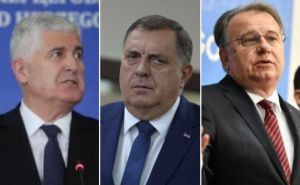
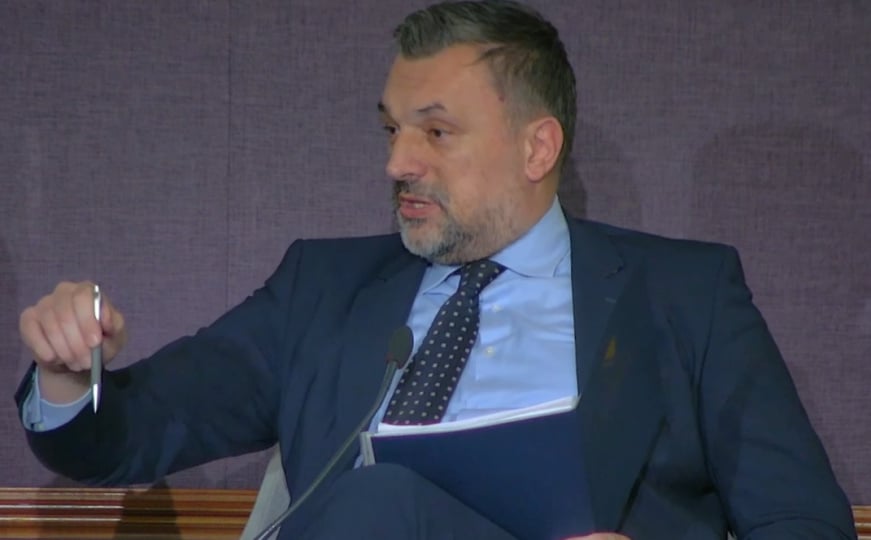
Similarly, Minister of Foreign Affairs Elmedin Konaković cannot represent either the Bosniak stance or the civic voice—not because he did not wish to, but because the organizers strategically set the framework that implicitly limited his participation. Unfortunately, Konaković entered a "three versus one" setup, in which controlling the pace and scope of the discussion was difficult, and the format and panel dynamics made his stance more defensive and narrowed the space for articulating civic and state arguments, while Čović, Cvijanović, and Radman calmly controlled the narrative and pace of the debate.
35 godina od Karadžićeve prijetnje i Izetbegovićevog odgovora: „Muslimanski narod neće nestati“
This dynamic further marginalized the genuine civic and political positions of Bosniaks, and by promoting the "third entity" narrative, Konaković was cast as a "problematic participant," while other participants appeared as more moderate and constructive actors. It is particularly concerning that, based on available information about the organization and participant selection, the conference seemed to give disproportionate attention to right-wing forces advocating a tripartite division of Bosnia and Herzegovina and the introduction of the so-called "third entity" concept, with the risk that this idea becomes normalized in the public as the "realistic" or "only possible" solution.
Such a focus further sidelines the civic perspective and the voices of those advocating for a functional, plural, and European-oriented state. Bosniaks are not solely a religious community but a political people with clearly articulated positions on the constitutional order, the functioning of the state, and its European and Euro-Atlantic future. While fully respecting the role and dignity of religious leaders, they cannot and should not replace political and civic representatives, especially when discussing constitutional models, institutions, rule of law, and international guarantees.
Even more problematic is the near-total absence of the question: where are the Bosnians and Herzegovinians as citizens? Where are the voices of those who do not reduce their political identity exclusively to ethnic or religious affiliation, but insist on equal citizenship, the rule of law, and functional institutions? Omitting the civic voice sends the message that civic positions in Bosnia and Herzegovina do not exist or are irrelevant, which is simply not true. Pro-Bosnian and civic positions are not merely a cultural or identity refrain. They entail very concrete principles: the rule of law, equality of citizens, protection of individual and collective rights through functional institutions, pluralism, a professional public administration, and a clear strategic orientation toward the European Union and NATO. Including these voices does not serve "balance for balance’s sake," but rather enhances the quality of the debate and reduces room for narrative manipulation.
It is also important to consider several other elements that often shape the tone and perception of a public event: who delivers the opening and closing remarks, how moderator questions are framed, who is given "major topics" (vision, constitutional concepts), and who is relegated to reactions, and whether the program is designed to produce easily "quotable" soundbites for the media rather than substantive discussion. All of this together determines whether the event is a genuine dialogue or a framework that preemptively narrows space for one side.
I believe that a broader and more inclusive composition of participants would significantly enrich future discussions and further strengthen the message of genuine support for Bosnia and Herzegovina and its European path. Specifically, it would be useful to include constitutional lawyers, the academic community, representatives of civic initiatives, local leaders, and experts on reforms and integration, so that the reality of Bosnia and Herzegovina is presented as it truly is: complex, plural, and political, rather than reduced to symbolic identity frameworks. When these voices are absent, the audience does not receive a balanced discussion but a simplified picture of Bosnia and Herzegovina as a space dominated solely by ethnic and religious politics. Such a narrative does not serve Bosnia and Herzegovina nor those who genuinely wish for its stability and European future. If the goal of such conferences is to contribute to dialogue and solutions, then it is essential to broaden the framework and include the civic dimension of Bosnian-Herzegovinian politics. This would not weaken the debate; on the contrary, it would make it more realistic, serious, and credible. However, it created the impression that the format favored the affirmation of a pre-set narrative rather than an open and balanced discussion.
About author: Adnan Hadrovic is a senior advisor to the Institute for Development Impact in Washington and a former Bosnian-Herzegovinian diplomat

Radiosarajevo.ba pratite putem aplikacije za Android | iOS i društvenih mreža Twitter | Facebook | Instagram, kao i putem našeg Viber Chata.
/ Najčitanije
/ Komentari
/ Povezano

/ Najnovije