View from Washington | Hadrović: Max Primorac and the Old Logic Behind New Divisions
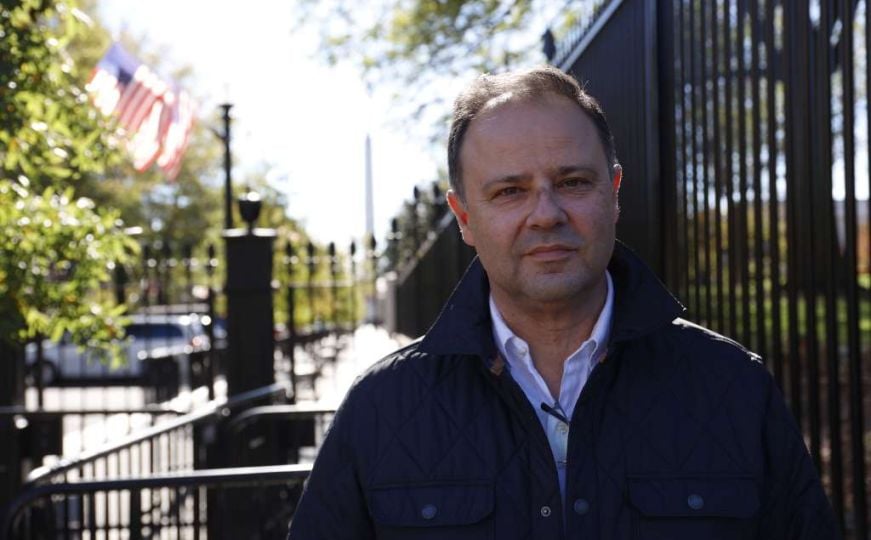
Max Primorac’s recent comments before the US Congress, where he floated the idea that Bosnia and Herzegovina needs deeper ethnic territorialization and maybe even a whole new entity, landed strangely for anyone who follows the country closely. It was presented as a practical suggestion, almost like rearranging administrative districts to improve efficiency.
By: Adnan Hadrović for Radiosarajevo.ba
But that is not what such a move would represent in Bosnia and Herzegovina, and treating it that way overlooks both the political history and the legal structure that have defined the country for nearly three decades.

Zekić iskreno pred okršaj sa Željezničarom: "Oni se bolje snađu i bolje razumiju derbi"
The Partition Story Keeps Coming Back
There is a reason partition argument never fully disappear in Bosnia and Herzegovina. They give the impression of simplicity in a place where politics are anything but simple. You hear the same refrain every few years: if institutions aligned better with ethnic boundaries, everything else would fall into place. It sounds logical on the surface, and that is precisely why it keeps returning.
But if this idea worked, we would have seen the results by now. Since 1995, Bosnia and Herzegovina has operated under some of the most rigid ethnic arrangements in Europe. Those arrangements have not reduced political tension. They have entrenched it. They produced political parties that survive by keeping mistrust alive, courts that struggle to impose decisions when powerful actors object, and administrations treated as patronage reservoirs. Anyone who has spent even a week inside the machinery of government there would recognize these patterns.
Identity matters, it would be naive to claim otherwise. But turning identity into territorial engineering has never solved Bosnia and Herzegovina’s governance problems. It has frozen them. A third entity would not break this cycle. It would multiply the incentives that keep the system locked.
Dayton Is Not a Choose-Your-Own-Adventure Book
One feature of these proposals is how casually they treat Bosnia and Herzegovina’s constitutional order. The Dayton Peace Agreement is not ambiguous on this point. Annex 4 defines the country as consisting of two entities. Changing that arrangement is possible, but only through the amendment process in Article X, which demands consensus across communities that simply does not exist. It is not something Washington can suggest into being, and it is not something domestic actors can pull off unilaterally.
The Peace Implementation Council has said this for years. So have the European Union and NATO. These positions are not accidental. They stem from the political math that has kept the region relatively stable, especially as leaders like Milorad Dodik continue to test the limits of the system. The point is not that change is impossible, but that change requires political agreement, and Bosnia and Herzegovina is nowhere near such agreement.
Then there is the matter of European legal standards. The European Court of Human Rights has issued rulings that Bosnia and Herzegovina must expand the right to run for public office beyond the current ethnic restrictions. Sejdić-Finci, Zornić, Pilav. These cases all push toward more civic equality. Creating a new ethnic entity would be difficult to square with that direction, and Brussels would certainly not pretend otherwise.
Pogled iz Washingtona | Hadrović: Max Primorac i stara logika novih podjela
The Actual Problems Are Governance Problems
If you ask citizens what frustrates them most, the answers are not mysterious. Slow courts. A sense that corruption goes unpunished. Public services that depend on who you know. A constant feeling that political elites, not institutions, determine outcomes. None of these problems have anything to do with whether the map has two entities or three.
The country needs better institutions, not more partitions. That means professionalizing public administration, reducing political interference in courts, opening up public procurement, and ensuring that budgets pass without hostage-taking. These are not dramatic reforms. They are the basics.
It is not a coincidence that most people, regardless of ethnic group, say they want to join the European Union. They are tired of living inside a system built on improvisation and political bargaining. EU integration offers an external anchor that Bosnia and Herzegovina has not had on its own.
New borders would undercut that process and empower actors who benefit from a weaker, less accountable state.
The same applies to the debate about the Office of the High Representative. There will come a time when OHR can close, but it will depend on meeting the five-plus-two (5+2) conditions. Those conditions exist for a reason. Until institutions function predictably, OHR serves as a backstop. Redrawing territory would pull the country further from those benchmarks, not closer.
A more stable Bosnia and Herzegovina will come from stronger institutions, not more elaborate territorial formulas. Partition has been tried. It has not delivered. The work ahead is harder, but it is also clearer: build a system where institutions, not ethnic engineering, shape political life.

Radiosarajevo.ba pratite putem aplikacije za Android | iOS i društvenih mreža Twitter | Facebook | Instagram, kao i putem našeg Viber Chata.
/ Najčitanije
/ Komentari
/ Povezano

/ Najnovije